

Loud Isn't Enough
How Marc Benioff’s most infamous early Salesforce campaign put a knife into software itself. A guest post by The Leverage’s Evan Armstrong


💡 This Week’s Big Ideas
✨ Jordan Mazer has curated a list of 19 companies that are hiring now after recently raising rounds
🤖 Box CEO Aaron Levie tells us that “Founders who understand what AI agents unlock will lead the next decade of startups.”
🌁 This Thanksgiving, Jon Lai is thankful for the people that make up Silicon Valley
💼 Join our talent network for more opportunities. If we see a fit for you, we'll intro you to relevant founders in the portfolio.

Today’s essay is a guest post by Evan Armstrong, founder and CEO of The Leverage, a newsletter about shifts in the tech market. For more from Evan, be sure to subscribe.
Evan argues that having a clear message makes all the difference when you’re trying to build awareness for your startup. We hope you enjoy it. —the a16z speedrun team

In normal times, startup marketing can often be genteel and orderly. When a platform shift is underway and there are billions on the line, however, things tend to become a bit more… aggressive. Pitches become battlecries as founders strive to stand out from the crowd of contenders.
Brash messaging and stunt marketing doesn’t always work, but the best founders use a more aggressive approach to draw attention to the product and the problem it’s solving, not merely to the company itself.
Marc Benioff understood this better than anyone.
It was February 22, 2000, and marchers in crimson t-shirts were pacing the sidewalks outside a San Francisco convention center, bellowing about software’s imminent demise. They waved signs, they chanted slogans. The scene was ridiculous, but that was precisely the idea. This circus was a Salesforce marketing operation, a stunt to promote Salesforce’s cloud-native CRM as an alternative to traditional on-premise software like the kind used by their competitors.
The target of Salesforce’s antics was competing CRM provider Siebel Systems, which had rented out the convention center for a customer conference.
Benioff had hired 25 actors, dressed them in bright red t-shirts emblazoned with “death to software,” and had them march with signs shouting slogans like “Red rover, red rover, software is over.” He even hired a fake news network called “Channel 22” to show up in a news truck and interview the protesters like it was a real political movement.
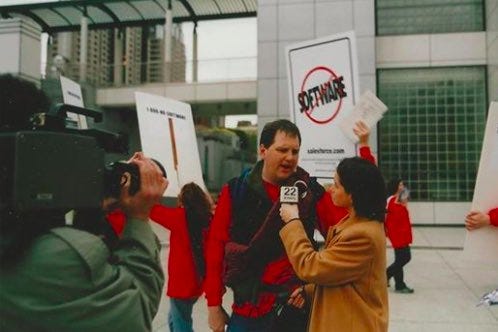
Benioff even considered hiring an armored tank driven by someone dressed as General Patton but decided that might be “too outlandish.”
When Siebel tried to respond by parking three semi-trucks in front of the center to block the protest, they just ended up blocking their own signage. Next, they called the police. This was a catastrophic error. Suddenly the tiny startup that nobody had heard of was all over the Wall Street Journal, Forbes, Business Week, and the New York Times. Business Week called Salesforce “the ant at the picnic”—which was exactly the underdog narrative Benioff wanted.
But Benioff wasn’t done. Later that same month, Salesforce threw their “End of Software” launch party at San Francisco’s Regency Theater with 1,500 attendees and a concert by the B-52s. To get in, guests had to bring old software discs to dump into overflowing trash bins. The party had “Software-Free” zones and games themed around the death of traditional software. It was theatrical, absurd, and once again, impossible to ignore.
Then came the Cannes taxi heist. Siebel held their most exclusive event in Cannes, France. Most executives flew into Nice and took a 45-minute taxi ride to the venue. So Salesforce rented every single airport taxi. They plastered the “No Software” logo on the cabs, hired drivers trained to pitch Salesforce, and turned a captive audience into a sales opportunity. Imagine being a Siebel executive stepping off your flight, looking for any cab, and discovering that every single one has been hijacked by your scrappiest competitor. Siebel called the police. Again.
In San Diego, at another Siebel event, they ran the same play with bike rickshaws. Over and over again, Salesforce was making it physically impossible to attend a Siebel event without encountering their message.
The genius was in the message behind the stunts, not the stunts themselves. Salesforce wasn’t saying “our CRM has better features than Siebel.” They declared the entire category of installed software obsolete. By pointing to the flaws of on-prem software, they made Siebel look like they were selling typewriters in the age of computers. Every IT executive who had suffered through a months-long Siebel implementation, every sales team dealing with buggy on-premise software, heard “The End of Software” and thought: yes, please, for the love of God, make it stop.
The “No Software” logo—the crossed-out software box that looked like the Ghostbusters symbol—became their calling card. Simple, memorable, instantly understandable. You didn’t need a PowerPoint deck to know what Salesforce stood for.
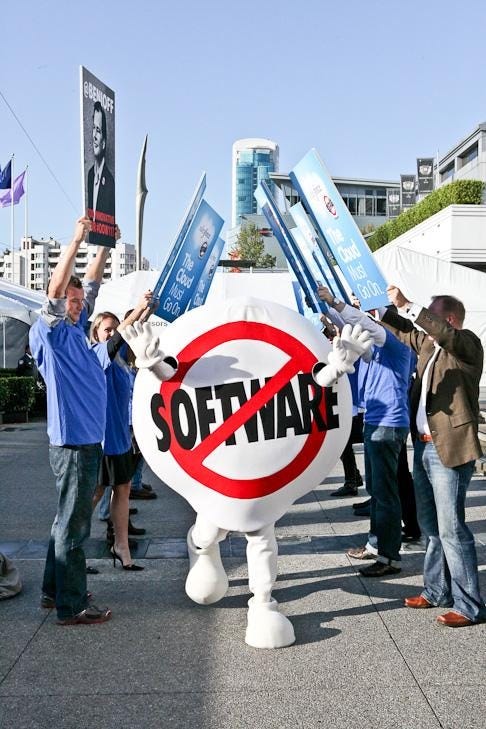
And the positioning was lethal because Benioff cast Salesforce as the underdog fighting the stodgy, bloated giant. When you’re David against Goliath, people root for you. When Goliath calls the cops on your peaceful (if theatrical) protest, people root for you even harder. Every time Siebel tried to shut them down, they amplified the message.
And it worked. The ant at the picnic became a $240+ billion company while Siebel ended up being acquired by Oracle. The scrappy startup that threw fake protests became the establishment they once fought against.
What Founders Can Actually Learn From This
Some founders will read this and think: “That’s a fun story, but it wouldn’t work today.” Benioff benefited from the relative peace and calm before we invented short-form video and memes. However, that attitude is missing the point. Benioff won because he correctly predicted the benefits of the shift to cloud, and then aligned his marketing to those ideas. In AI today, too many early stage founders just say some variation of “[INSERT ADJECTIVE] intelligence,” tell customers they will make them 10x more efficient, and get back to coding. Remarkably, this has worked for the last few years, but as AI starts to saturate it will take deliberate positioning to stand out once again. Salesforce’s story has five takeaways:
Create a villain, not just a competitor. Salesforce could’ve just gone with a “here’s why the cloud is better” pitch. Instead, they made Siebel represent everything broken about the old world.. When you have a villain, you have a story, and stories spread. Feature comparison charts don’t.
Make it visceral and physical. The red shirts, the crossed-out software logo, the fake protests, the hijacked taxis were things people could see, touch, photograph, and talk about. It was dead simple and inherently viral (even pre social media!).
Attack the category, not just the leader. Salesforce didn’t try to be “better software.” They declared software itself dead. By making the problem existential, it made their product more important.
Relentless beats clever. One protest was memorable. But the protest, then the party, then the Cannes taxis, then the San Diego rickshaws—that’s a campaign. Most founders do one creative stunt and then retreat to safety and easy Google Ads. Don’t be lazy or simply bask in the success of your first idea. This has to be a team or skillset you build up internally so that the motion never slows down.
Always punch up, never down. This playbook only works when you’re smaller than your target. The instant Salesforce became the incumbent, these tactics would look desperate and bullying. Know your position in the power dynamic and act accordingly.
The uncomfortable truth is that most B2B founders are too scared to do anything remotely like this. They’ll read this essay, think it’s entertaining, and then go back to optimizing their conversion funnels. They’ll worry about being “professional” or “appropriate” or “too aggressive.” They’ll convince themselves that stunts don’t work in their specific vertical. And that’s fine—that’s why there’s still opportunity.
The founders who actually have the guts to identify a clear villain, position against an entire category, and relentlessly show up where their competitors are the ones who build the next Salesforce. Everyone else is just renting market share until someone braver shows up.
Like this post? Forward it to your team! And be sure to subscribe to Evan Armstrong’s newsletter, The Leverage.
For more weekly dives into the world of early stage startups, subscribe to our newsletter below.

You are receiving this newsletter since you opted in earlier; if you would like to opt out of future newsletters, you can unsubscribe immediately.
This newsletter is provided for informational purposes only, and should not be relied upon as legal, business, investment, or tax advice. You should consult your own advisers as to those matters. This newsletter may link to other websites and certain information contained herein has been obtained from third-party sources. While taken from sources believed to be reliable, a16z has not independently verified such information and makes no representations about the enduring accuracy of the information or its appropriateness for a given situation.
References to any companies, securities, or digital assets are for illustrative purposes only and do not constitute an investment recommendation or offer to provide investment advisory services. Any references to companies are for illustrative purposes only; please see a16z.com/investments. Furthermore, this content is not directed at nor intended for use by any investors or prospective investors, and may not under any circumstances be relied upon when making a decision to invest in any fund managed by a16z. (An offering to invest in an a16z fund will be made only by the private placement memorandum, subscription agreement, and other relevant documentation of any such fund which should be read in their entirety.) Past performance is not indicative of future results.
Charts and graphs provided within are for informational purposes solely and should not be relied upon when making any investment decision. Content in this newsletter speaks only as of the date indicated. Any projections, estimates, forecasts, targets, prospects and/or opinions expressed in these materials are subject to change without notice and may differ or be contrary to opinions expressed by others. Please see a16z.com/disclosures for additional important details.
 | A guest post by
|
Since 2000, Salesforce has become the villain. Outdated, over-priced, over-complicated. Bullying customers. Cashing in on convincing customers migrating away is too hard, too expensive.
Great article. “Benioff one because he correctly predicted the benefits of the shift to cloud, and then aligned his marketing to those ideas.” You meant to say “Benioff won” instead of “Benioff one”