

The Fluency Test: How Demis Hassabis Learned to Tell Conviction From Delusion
Author Sebastian Mallaby spoke with us about his latest book, “The Infinity Machine,” and the beliefs that connect those who choose to bet on themselves.

This Week’s Big Ideas 💡
🏰 Jon Lai proposes the “minimum viable moat” as the way to win in AI
🤖 Andrew Chen has a simple rubric for telling the difference between AI-native products and products with AI bolted on as an afterthought
💰 Emily Bennett has advice on fundraising: don’t lead with your “dream investor.”
💼 Join our talent network for more opportunities. If we see a fit for you, we’ll intro you to relevant founders in the portfolio

Somewhere around 2003, in a room full of investors, a video game crashed.
The game was called Republic: The Revolution, and it was supposed to be a generation-defining political simulation. Its creator, a young Londoner named Demis Hassabis, had pitched it with the kind of total conviction that makes people open their checkbooks. The demo failed. The product barely functioned. But Hassabis forged ahead, telling investors a story about what the game would become.
Ultimately, the game shipped to middling reviews, and Hassabis’s company, Elixir Studios, folded. Hassabis went quiet for a few years, then started a small research lab called DeepMind. Everyone in Silicon Valley knows the story from here. Google acquired DeepMind and the company has gone on to develop technologies that power Google’s frontier AI models, and which have earned Hassabis the Nobel Prize in Chemistry.
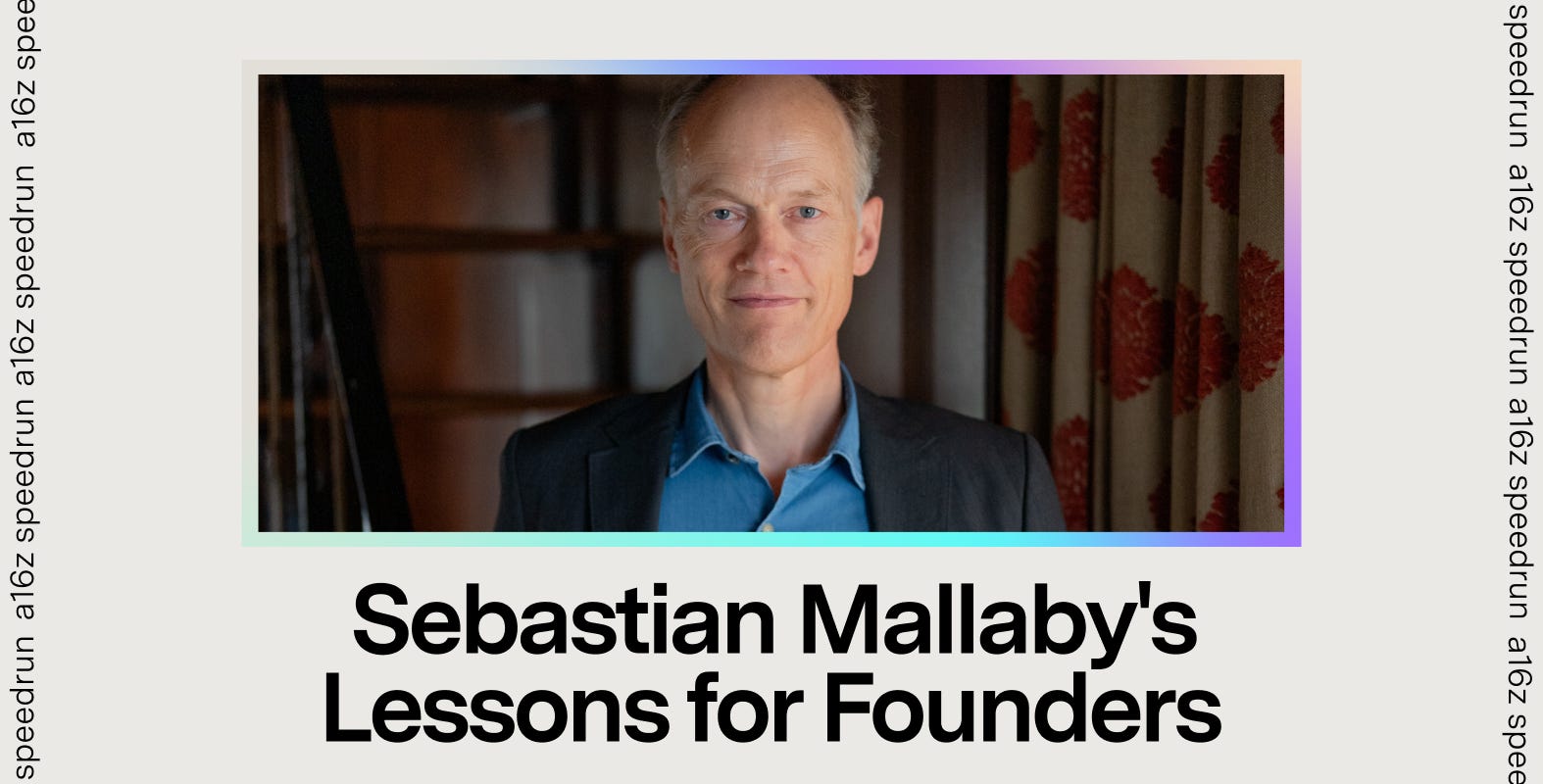
Sebastian Mallaby has been writing about entrepreneurs like Hassabis for twenty years. His book More Money Than God went inside hedge funds, The Power Law chronicled venture capital, and his new book, The Infinity Machine, tells the story of Hassabis and, through him, the story of how modern AI came to exist.
We spoke with Mallaby about what he’s observed across all three of these worlds, and why the Hassabis story might be more useful to founders than they realize.
Conviction Vs Delusion
Hedge funds, startups, venture capital: in each case, a small group of people has decided that everyone else has it wrong, and is betting real money on that belief. These are all fields where the gap between conviction and delusion is essentially invisible from the outside. The only thing that separates them is the outcome.
We asked Mallaby: Is this tension between conviction and delusion the real throughline connecting your work?
“I think that’s a fair characterization of the whole investment boutique entrepreneurship ecosystem,” Mallaby said. “In hedge funds, you’ve got market prices which you think you can outguess, and those market prices are the weighted average of intelligent people’s judgment. So you need to be quite bold to think you know better. In the same way, a startup entrepreneur is trying to disrupt incumbents who are not idiots. You have to be bold.”
But the line between conviction and delusion can at times appear thin. And as Mallaby tells it, even the most successful founders have found themselves on both sides of that line.
The Fluency Test
One of the early stories told in The Infinity Machine recounts how the dev team on Republic: The Revolution slipped into a pattern of delusional belief about the game’s chances at success. “The engineers knew he [Hassabis] wouldn’t accept anything short of ‘yes, we can do this,’” Mallaby told us. “So they said that. And that made Hassabis even more determined not to accept no for an answer. Because he was hearing yes from his own team, he got even more confident. There was this feedback loop.”
What matters about this story is what happened after. Mallaby frames the Elixir collapse as the event that made DeepMind possible.
Years later, facing a similar crossroads with AlphaFold, Hassabis found himself in the position of deciding whether to push a team past the point where its own leader said the goal was impossible. The head of the AlphaFold effort, Andrew Senior, told him flatly in 2018: we’ve built the best protein-folding system in the world, but we cannot do what you’re asking us to do. Instead of overriding him, Hassabis began sitting in on meetings with the broader team and listening closely for what Mallaby calls “the fluency of the conversation.”
“If lots of ideas are coming up, he figures, well, it’s not like they’re stuck,” Mallaby says. “If they had more time or resources, they could test out some of these ideas they’re kicking around in the conference room. Fluency was his metric for whether to go ahead.”
A room full of people generating ideas looks fundamentally different from a room that’s gone quiet. The first means there’s potential. The latter means the problem might be a dead end. The fluency test was how Hassabis learned to tell the difference, and it was a lesson hard-won by a founder who’d experienced the downsides of charging ahead when the room was telling him what he wanted to hear.
Mallaby put the takeaway plainly: “I think it’ll resonate with a venture capital firm that second-time entrepreneurs are often the ones you most want to back.”
On Communicating Conviction
For many practical and structural reasons, the dominant way that Silicon Valley founders talk is prospective. You announce what you’re going to build before you’ve built it. You generate excitement around a future state that may or may not arrive. Some of the most visible figures in tech have operated this way for years, tweeting about ambitious new capabilities before the technology can deliver them. It works as a fundraising mechanism. It also, as Mallaby noted dryly, sometimes involves announcing things that aren’t yet certain to work.
Hassabis, at least in his mature period, worked in the opposite direction. After DeepMind’s Atari system started producing real results in 2013, his instinct was to take the concrete achievement and wring every possible drop of credibility out of it. The target he picked was Nature magazine. “Nobody else on his team thought that publishing a paper in Nature was even conceivable,” Mallaby said. “Nature didn’t really do computer science. But Hassabis cultivated an editor at Nature for a year, then got him to agree to look at a submission from DeepMind, then got the DeepMind video team to design cover art so Nature would put it on the front.”
These kinds of details accumulate throughout the book. Hassabis comes across as someone who wastes very little, who finds a use for whatever’s already lying around, and who treats reputation as a resource to be deployed strategically rather than as a mere byproduct of the work.
“He was absolutely as focused on communication as anyone else in AI,” Mallaby said. “But he had this retrospective approach, of playing up actual achievements, as opposed to announcing future ones.”
On Timing and “Scientific Taste”
Marc Andreessen likes to say that one of the main reasons great entrepreneurs fail isn’t because their idea is wrong, but because they were simply too early. Predicting when the market is ready for something is one of the hardest jobs of the entrepreneur, and a thread running through Mallaby’s book is that Hassabis foresaw a lot of things before others, including the possibilities of reinforcement learning and the possibility of delivering something meaningful for the protein folding problem.
Mallaby told us that Hassabis uses the phrase “scientific taste” to describe the ability to sense when a field is about to tip, even when most observers still see stagnation. It’s a phrase that does a lot of quiet work, treating taste as pattern recognition operating at the boundary between what the data supports and what it merely suggests: the ability to read straws in the wind when everyone else is staring at the ground.
“With DeepMind’s Atari agent, which is an early experiment in combining deep learning with reinforcement learning, Hassabis sees when something is poised to advance,” Mallaby said. “And then he repeats the same trick with the decision to go after AlphaGo, even though Sergey Brin had told him it’s crazy. After Atari he feels you can do Go. Later, after Go, he feels you can do protein folding.”
David Silver, one of DeepMind’s key researchers, gave Mallaby a metaphor for this: Hassabis had understood “the ladder.” Each project was grander than the last, and each one funded the next: financially, and in terms of credibility. To get to the moon, the DeepMind team figured out which rung to stand on next.
Internally, the DeepMind team ran two modes at once: a cheap exploration layer, where researchers pursued open-ended questions, and an expensive exploitation layer, where strike teams poured everything into a single target. Hassabis’s job, as Mallaby described it, was knowing when to shift from one to the other. “He’s willing to have people exploring different avenues for AI, doing their thing,” Mallaby said. “But then he’s going to have the scientific taste to know which one to push on. And when he’s pushing, it’s a totally different organizational structure.”
How to Predict the Future
We asked Mallaby whether, after spending years embedded in this story, he felt he understood where AI was actually going. He gave a modest yes.
“My view is, if you look at what’s happened since ChatGPT came out, the number of major jumps that the technology has made is flabbergasting,” he said. “You go from something which basically hallucinated nonstop to something that pretty much got that under control. Longer context windows. Multimodal. Reasoning. Now it’s starting to be agentic. Next is world models. And it’s only been three and a half years.”
Every time someone declares a ceiling, Mallaby pointed out, a new axis of scaling appears to replace the one that supposedly ran out. He’s bullish on infrastructure. The application layer, he admitted, is anyone’s guess.
But the question we kept circling back to was the one about conviction and delusion, and whether there was any reliable way to tell them apart before the outcome settles the matter. Mallaby’s answer, when it finally came, had the weight of someone who has spent two decades in rooms with people who stake everything on their own judgment.
“You don’t necessarily get the balance correct the first time,” he said. “But the only way you learn is by doing.”
The Elixir game crashed, and the company died, and then the same person started something else.
Thanks to Sebastian Mallaby for speaking with us. And for more weekly dives into the world of early stage startups, subscribe below.
Demis Hassabis is a Must follow in Tech & Science.