

Substack CEO Chris Best: "You can't define success as 'no one is ever mad at us.'"
The CEO of this app on the challenges that face early stage founders

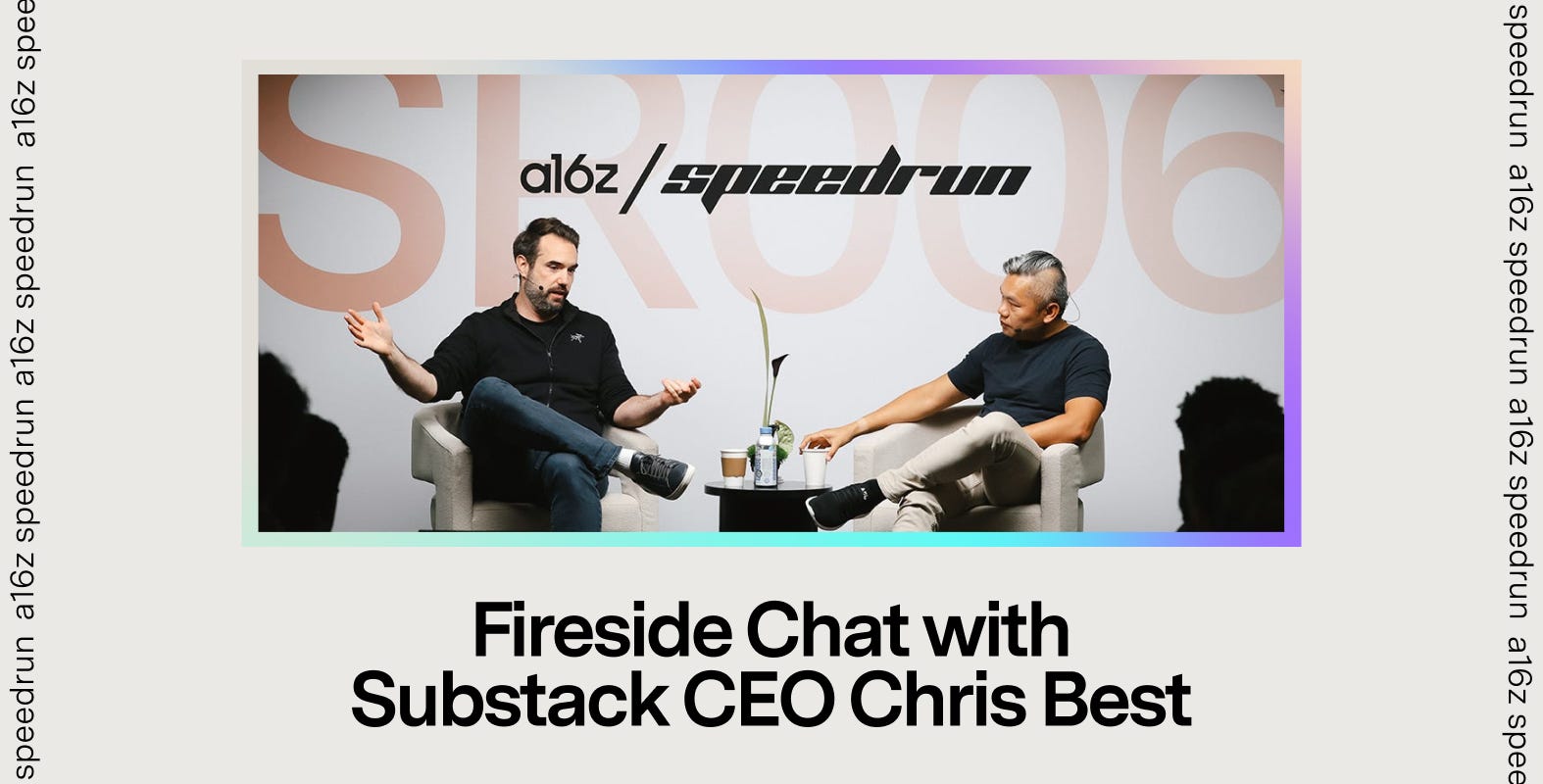
Chris Best is the CEO and cofounder of Substack, a platform you’re likely aware of.
In a fireside chat with a16z speedrun GP Andrew Chen, Chris shares his founding story, discusses how to navigate controversy, and makes the case that having strong values matters more than pleasing everyone.
Watch the full talk:
Our top takeaways below 👇
1) Look for missionaries, not mercenaries
Best traces Substack’s origins to an essay. He was writing about his frustrations with the media economy on the internet. As he put it, he was “going on this unhinged tirade about how Twitter was driving us all crazy.” He sent it to his friend and future cofounder, Hamish McKenzie.
“Hamish kind of let me down gently. He said, ‘Your essay sucks. It’s boring. Anybody can complain. Everybody knows the newspaper industry is dying. The more interesting question is: what would you do about it? How could it be different?’ For me, the idea to start a company came from the idea to do something that mattered.”
Best invoked Jeff Bezos’s framing of mercenaries versus missionaries. The missionaries tend to win, he argued, because they’re the ones who stick around when it gets hard.
“One of the counterintuitive things is that the people who are in it for the love of the game often end up in the ranks of the very most successful. Along the way there are moments: ‘Do you want to sell? Do you want to get out? Do you want to make a buck?’ Those things come. I don’t think Substack would have worked if we were just trying to make money. It’s not the company you would start if you’re looking for the fastest way to riches.”
He also pointed out a hiring advantage that early-stage founders tend to overlook: when your company isn’t cool yet, the only people who show up are true believers:
“The only reason a brilliant software person was going to come work at Substack was because they believed in what we were doing, and that’s an advantage you should treasure while you have it.”
2) Have a sci-fi vision and a short-term plan
When Andrew Chen asked about Substack’s product evolution, Best laid out his framework for how to build a company. It produced one of the most quotable lines of the conversation.
“You want to have a sci-fi vision and a short-term plan. The whole middle ground often fucks you up.”
“If you only have a short-term plan, you end up on this random walk where you can’t get out of your local maximum. And you can’t recruit someone by saying, ‘We’ve got a really good two-week plan and then we’ll figure it out.’”
But the opposite failure mode, a rigid multi-year roadmap, is just as dangerous. What works is holding a massive, almost absurd vision alongside a very concrete next step.
“We had this incredibly big vision: a new economic engine for culture, a new social contract, a renaissance. But that’s not a business idea. That’s a college-freshman-pot-smoking idea. So we also had this really concrete first step: make it dead simple to start a paid email newsletter. I don’t know exactly what all the steps are between ‘paid email newsletter’ and ‘insane cultural renaissance across the galaxy.’ But I know this is closer, and I can see the next couple of steps. When you have both of those ingredients, that’s how you can make progress.”
3) People hate stuff that sucks
On the topic of AI and creativity, Best argued that creators aren’t wrong to be annoyed:
“People actually hate stuff that sucks. And a lot of stuff that gets made with AI right now sucks.”
He illustrated the point with a story about a viral tweet.
“There was this video, really high production value, of an egg roll pooping out a spring roll into a deep fryer. Incredible technical thing. And the person tweeting about it is like, ‘Creative people, your days are over. The machine can do everything you do now.’ And if you’re somebody that makes movies, you look at that and think, ‘This person’s a fucking moron.’ And in their mind, the next step is: all this AI stuff is bullshit.”
“That’s obviously not true. We’re at the start of the most incredible technical revolution of my lifetime. It’s going to change everything. And it’s not going to substitute for taste. An egg roll pooping a taquito is not it.”
Best drew a parallel to his own experience watching AI coding tools improve, from barely functional a couple of years ago to genuinely transformative by late 2024. Something that’s 80% good enough is actually 0% good enough, he said. But when it hits 99%, everything changes.
4) Don’t hand control of your company to your critics
Substack’s stance on freedom of the press and freedom of speech has, at various points, made the company a lightning rod.
“We’ve taken a strong stand in favor of freedom of the press, freedom of speech. We think it is a crucial piece of that economic engine we’re trying to build. We’ve been through a number of moments where that’s been hard, where there’s somebody on Substack that people are like, ‘Why do you allow this? Why is this allowed to be here? Why don’t you just do what everybody else does and kick this off and get rid of it?’
“...We’ve been through left-wing censorship and right-wing censorship and we’ve kind of got now, eight years in or whatever, we’ve got this long track record that we can point to of being principled on this issue that I think not many others have.”
Best says they’ve weathered cycles where their stance was popular and cycles where it wasn’t, and that the political valence of the criticism has shifted more than once. His view: you need to know what you stand for before the pressure hits.
“There are moments where if we had bent from our principles, it actually would have killed us. If we started to hand over the moral authority, to say, ‘What do we think? How should Substack work?’ to whoever’s the loudest or most painful objector… giving that up would have handed control of the company to our critics. And it would have killed it.”
“The only way to make a company where nobody ever gets mad at you is to not succeed. It’s impossible to be number one at something, to be impactful, and not have some people hate you… You can’t define success as ‘no one is ever mad at us.’“
5) “I don’t want it in the abstract, but I do want it in the specific”
Best closed with a story about how he used to pitch Substack in its earliest days, and the reaction he kept getting.
“In the early days, I had this parlor trick. I would explain what the platform was: It’s a way that writers can go independent and make money on the internet. And people would be like, ‘Yeah, that sounds kind of cool, but nobody’s going to pay for that. I don’t want to pay money to get more email.’”
“And my parlor trick was: ‘Well, who’s your favorite writer?’ And they’d say, ‘It’s so-and-so.’ And I’d say, ‘Would you pay five bucks a month for them?’ And they’d say, ‘Yeah, for them I would, but that’s different. That’s somebody I really care about.’”
“You had this feeling of: ‘I don’t want it in the abstract, but I do want it in the specific.’ That’s a sign that you’re onto something.”
That instinct was validated early by Substack’s very first customer, Bill Bishop, who generated $100,000 in revenue within hours of launch. It gave Best and his co-founders the courage to keep building, even through the long stretches where growth was slower than expected.
“Professional gamblers often start their career with a winning streak,” Best joked. “We lucked out. We had this first customer that not only gave us the momentum, but gave us the courage of our convictions.”
Like this post? Forward it to your team! And for more weekly dives into the world of early stage startups, subscribe below.

Outstanding video!