

On Dealing With Rejection as a Founder
Some advice on what to do when you run into barriers.


Engineers, come meet us! During next week’s Tech Week SF we’ll host a breakfast for engineers who are in school (or within 5 years of graduating). Come meet the a16z speedrun team, including GP Andrew Chen, and learn what it takes to get funded by a16z speedrun while enjoying some waffles and açaí bowls. Apply here.

💡 This Week’s Big Ideas
🧊 Come meet our team at Tech Week SF (Oct 6–10) and LA (Oct 13–17)! See the full list of a16z speedrun events for San Francisco and Los Angeles.
💫 Some amazing startups from the class of SR005 launched this week. Check out these viral launch videos from Taya, High Agency, and OpenSesame.
🐦 “The best advice I got early on was to play positive sum games,” writes Robin Guo. “People will naturally help people they like.”
🎉 On Oct 9th Bella Nazzari is throwing a party for people who’ve recently moved to San Francisco. Details in thread.
💼 Join our talent network for more opportunities. If we see a fit for you, we'll intro you to relevant founders in the portfolio.
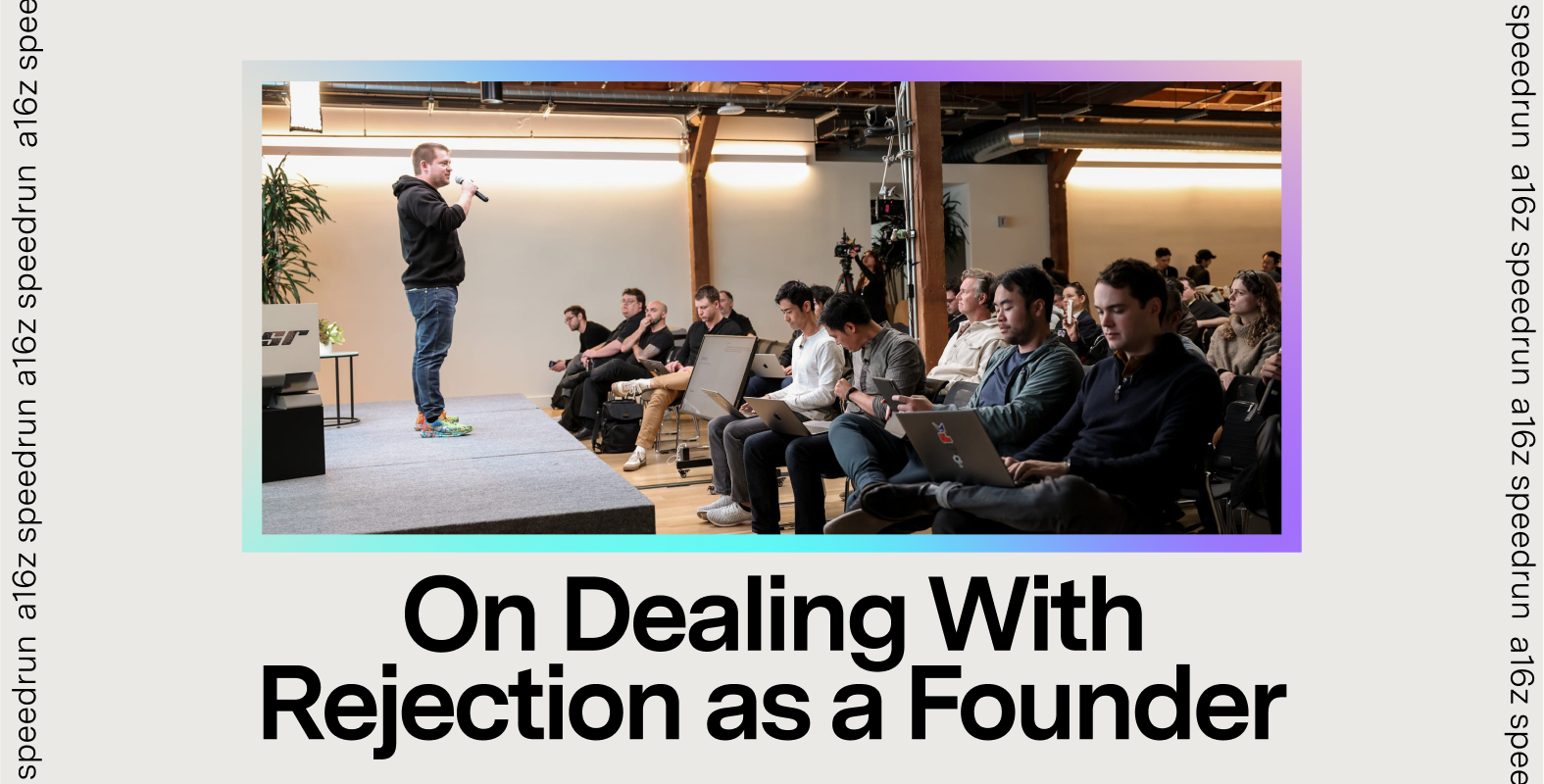
Natan Voitenkov walked into the meeting feeling confident. He and his cofounders were set to pitch to an investor that had been described by others as “friendly.” And Voitenkov had plenty of reasons to feel optimistic: His startup, Genway AI, had already leapfrogged many other barriers in their way, including getting backed by speedrun.
But once the meeting started, the mood soured. “The entire meeting was spent with him scowling at me, lecturing us on CAC, LTV, and ACV,” Voitenkov says. Worse, he felt he’d been embarrassed in front of his team. “I left convinced I had failed,” he says, “certain my co-founders would lose trust in me.”
Instead, Voitenkov’s cofounders encouraged him. “They told me they’d never work with someone like that, and that they admired how I handled the situation,” he says. “That’s when I realized the true value of cofounders.”
Three Ways to Handle Rejection as a Founder
Rejection is something you face constantly when building a startup. As Hedra CEO Michael Lingelbach put it in this newsletter two weeks ago: “You face rejection when recruiting, you face rejection when fundraising. Even if a team seems successful, they’ve all gone through a lot of rejection.”
Rejection is simply an inevitable part of the process of building a startup, even for the best teams. With applications for SR006 officially closed as of this past Sunday, our team of investors is now hard at work reviewing applications and selecting the teams for the next cohort of speedrun. But for every offer we extend, we’ll also be sending out around 200 rejection notes. A little over 14,000 teams applied for SR005, and fewer than 0.5% were ultimately accepted. That means we’re necessarily passing on an enormous number of talented people with strong ideas.
1. Prep for the Next Application Window
The good news for speedrun applicants is that there really is no downside to just applying again to the next cohort when applications re-open in ~5-6 months. In fact, a16z speedrun investor Troy Kirwin estimates that about 30% of the teams in his cohort for SR005 had at least one founder that previously applied—and was rejected—for an earlier batch.
These stories naturally tend to get edited out of the narratives that founders tell online. When we spoke with a couple of the repeat applicants in Kirwin’s cohort, more than one downplayed their previous efforts. “Oh, maybe I applied a year ago,” one mused. “We applied to a lot of things back then.”
So it goes. But it raises the question: what makes an application more likely to draw investor interest on the second try? This is something we’ve addressed in detail here in the following post about what the a16z speedrun investors look for in applications:
TL;DR: Traction with customers is the most powerful signal we’re interested in, along with the pedigree of the founding team and the relative opportunity size of the idea being pursued.
Given this, it follows that if you have an idea you really believe in, doubling down on proving your idea’s merits by delivering something of value for real, paying customers.
2. Focus on Customers and Revenue
When investors talk about “traction,” it refers to several possible metrics. For pre-revenue startups, it might include a growing email waitlist, viral tweets, or fanatic engagement data from early testers.
But for companies with a product in the wild, we believe one metric is king: revenue.
Genway’s Natan Voitenkov puts this point neatly:
“Throughout my journey from inception to seed, I have encountered three major types of rejection: from investors, from customers, and from potential hires. Putting these experiences into perspective is essential. While investor rejection can feel intimidating, it is ultimately customer rejection that matters most—because, as the saying goes, revenue solves all problems.”
Getting revenue traction isn’t just one of the best ways to draw investor interest—it’s also often the best way to extend your runway. And in the process of pursuing paying customers, you may even discover new problems that clarify your startup idea or lead to a more fruitful pivot.
3. Ignore the Haters and Lock In
This is perhaps the most ironic possible advice to give within the context of a newsletter with “a16z” branding, but the simple truth is that investors can and often do get it wrong, and sometimes you should ignore our advice. No investor is likely to know as much as you do about the market you’re building for, so it’s possible that getting rejected by investors—including when applying for a program like a16z speedrun—isn’t actually that useful of a signal.
One last quote from Voitenkov illustrates this point nicely:
In the context of raising capital, I often remind myself that even the best in class investors are wrong nearly 90% of the time. Ask yourself: how many dates did you go on before meeting your significant other? Fundraising follows the same principle. To raise capital, one must be prepared to face numerous rejections. Ultimately, it is a numbers game—much like dating.
Like this post? Forward it to your team! And thanks to Natan Voitenkov for speaking with us for this one. Be sure to follow him on X.
For more weekly dives into the world of early stage startups, subscribe to our own newsletter below.

“Even the best in class investors are wrong nearly 90% of the time. Ask yourself: how many dates did you go on before meeting your significant other? Fundraising follows the same principle.”
Rejection reframed like this takes so much sting out of it. Do you think founders should treat investor meetings less like evaluations and more like discovery calls for mutual fit?
Haha this was timely with the applications closing a few days ago! ;)