

The Growth Meta: Should Founders Be LinkedIn-Maxxing?
Embrace the cringe

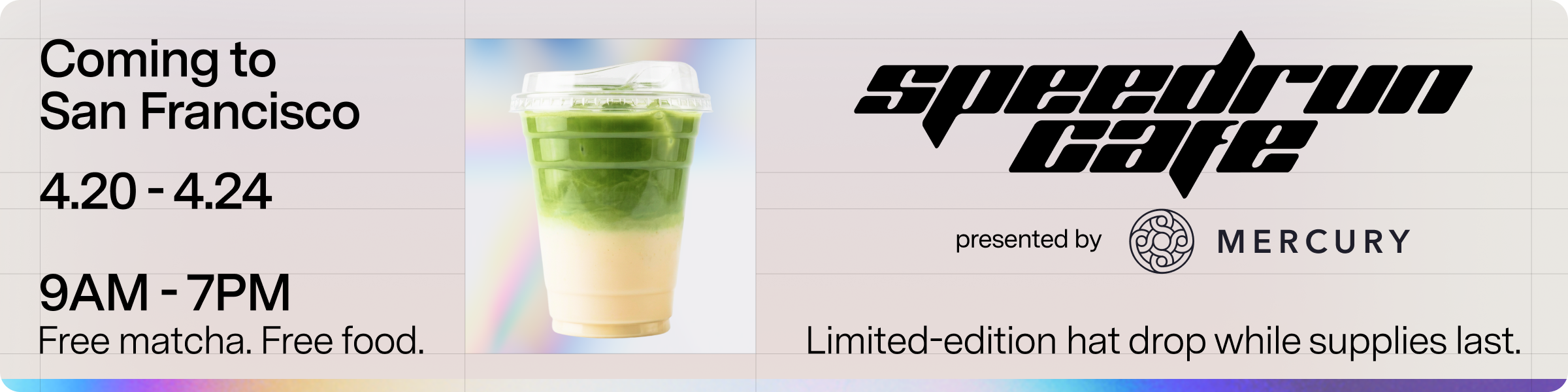
SPEEDRUN APPLICATIONS ARE OPENING SOON! And we’re coming to SF.
Join us at the pop-up speedrun cafe (presented by Mercury) in SF during the first week of the SR007 application window: April 20th–24th! Each guest can snag a drink, a food item, and a limited-edition hat (while supplies last).
RSVP on Partiful using the links below to reserve your spot on one of the five days:
Monday (4/20) | Tuesday | Wednesday | Thursday | Friday (4/24)

This Week’s Big Ideas 💡
💻 Andrew Chen comments on the growing wave of non-technical founders using AI coding tools to build companies: “their iteration speed is 10x.”
🪞 Mirror Mirror AI (SR006) founder Yusan Lin explains why she’s building infrastructure for people to own their own likenesses in the AI era.
🛠️ Bella Nazzari explores job openings for the growing discipline of “gtm engineering.”
💼 Join our talent network for more opportunities. If we see a fit for you, we’ll intro you to relevant founders in the portfolio
Every founder is trying to crack distribution. They’re posting on X, debating whether to start a podcast, and wondering if doing the latest viral trend on TikTok is worth the effort.

Meanwhile, LinkedIn is sitting right there—wildly underutilized and practically begging early-stage founders to use it. Eventually, this channel will be saturated like everything else. But for now, for the willing founder, we believe there are customers to be had.
The LinkedIn meta is driven by two factors:
The audience is already there, pre-qualified. Every other social media fight is a slugfest between political takes, culture war brainrot, an algorithm that changes weekly, while you’re earnestly posting about your latest feature. In contrast, LinkedIn’s feed is overwhelmingly professional. The people scrolling it are decision-makers, investors, hiring managers, and operators looking for “work” content. If you’re selling to businesses or raising money, your buyers are literally browsing between meetings. manager.
The algorithm is generous. LinkedIn’s distribution is still in growth mode. A post from a 7,000-follower account can get 850 likes and 184 comments—that’s what happened when Salar Shahini of Sweatpals (SR004) announced his team’s $12M raise. That’s a 12%+ engagement rate! The platform actively rewards original posts, especially from personal accounts (not company pages).
What actually works on LinkedIn
After watching hundreds of founders go through speedrun, here are some tips for making performant posts:
Post your actual numbers.
The highest-performing LinkedIn posts from speedrun founders are almost always the ones sharing real metrics. No one wants to read your thoughtslop pieces about vibe coding. Just follow the example of Daniel Dhawan of Rork (SR005)—he posted that Rork users had created over 500,000 projects with 2,000+ apps published to the App Store, hitting #2 in the US Dev Tools category” and let the numbers do the work. Specificity is the currency of trust on LinkedIn. Vague “excited to announce” posts get polite likes from your mother. Actual numbers get inbound leads.
Build in public, but make it a narrative.
Taylor Offer of Atrios (SR005) makes each post build the narrative around his company. He posts about the emotional arc of founding (”Don’t forget how bad you wanted what you currently have” got 44,000+ likes), the tactical realities of scaling, and meta-observations about the platform itself. His audience feels like they’re following a character in a show. Treat LinkedIn as a serialized story to build the kind of following that actually converts into quality leads. As we’ve discussed before, early sales is about people loving the founders first and the product second.
Use your pre-founder credibility.
Your career before your startup is a feature, not baggage. Eric Berman of Lil Snack (SR002) was a Hulu and Crunchyroll executive before founding an AI gaming company. Paddy Lambros of Dex (SR005) ran talent at Atomico, so when he posts about building an AI recruiter, his network of recruiters and hiring managers actually believes what he says. If you spent years in an industry before founding a company in that space, your LinkedIn network is your first customer list.
Don’t overthink the format.
The posts getting the most engagement from speedrun founders are almost comically simple. A photo with a short story. A screenshot of a metric. Michael Lingelbach of Hedra (SR002) posts about AI video breakthroughs in a few short paragraphs—no carousels, no “10 things I learned” threads, or graphic design. His $32M Series A announcement was straightforward and still generated dozens of comments from exactly the audience Hedra wants. LinkedIn rewards “authenticity” over production value. A real photo from your office beats a Canva graphic every time.
How to survive the trough of cringe
Let’s be very clear: the first few LinkedIn posts feel terrible. You’ll write something, hover over the post button, and wonder if your college roommate or former boss is going to think you’ve lost your mind. Call it the “trough of cringe.” Every founder who’s now crushing it on LinkedIn went through it.
The discomfort is a competitive advantage. It’s the barrier that keeps your competitors from doing this. If posting on LinkedIn felt natural and easy, everyone would do it and it wouldn’t work. So start with what you know is true. Write about something you genuinely experienced this week: a customer interaction, a technical decision, a number that surprised you. The bar for “good LinkedIn content” is lower than you think because most people aren’t posting anything at all.
The cringe fades. And unlike paid ads or PR agencies, it’s free. The only cost is your willingness to hit “post.”
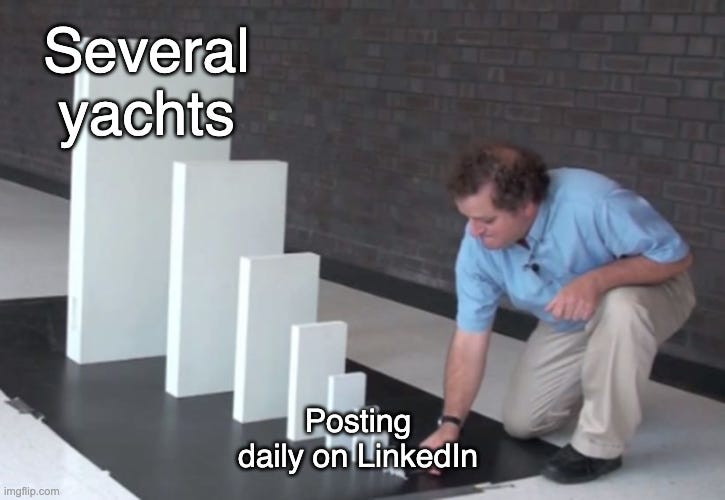
That’s it for this week!
For more weekly dives into the world of early stage startups, subscribe below.
the cringe tax is sooo real but the distribution is too good to ignore right now...
The meme in the end , too good 😂😂