

Jack Altman's 5 Lessons on Finding Product-Market Fit
Takeaways from a fireside chat between the Alt Capital founder and a16z’s Marcus Segal


We just launched a16z speedrun Alpha, a selective fellowship for exceptional students and recent-grad engineers who want to build startups, either by joining a breakout portfolio company at the ground floor or starting one themselves.
Getting in earlier can change the slope of your career. If you’re already shipping, there’s no reason to wait.
Alpha has two tracks:
You can either join a fast-growing portfolio company full-time, and get hired directly as an engineer building core product alongside founders and early teams
Or you can receive $20K equity-free grant upfront to go all in on exploring an idea, with eligibility for up to $250K in investment from us later.
In June, the first cohort of Alpha will kick off with a retreat alongside the speedrun team, followed by 8 weeks in person with some of the smartest engineers and operators in the ecosystem. Companies started by Alpha fellows will receive fast-tracked consideration for a16z speedrun.
We’d love to have you apply. And if you know someone who should see this, please feel free to forward.
Become a fellow —> alpha.a16zspeedrun.com

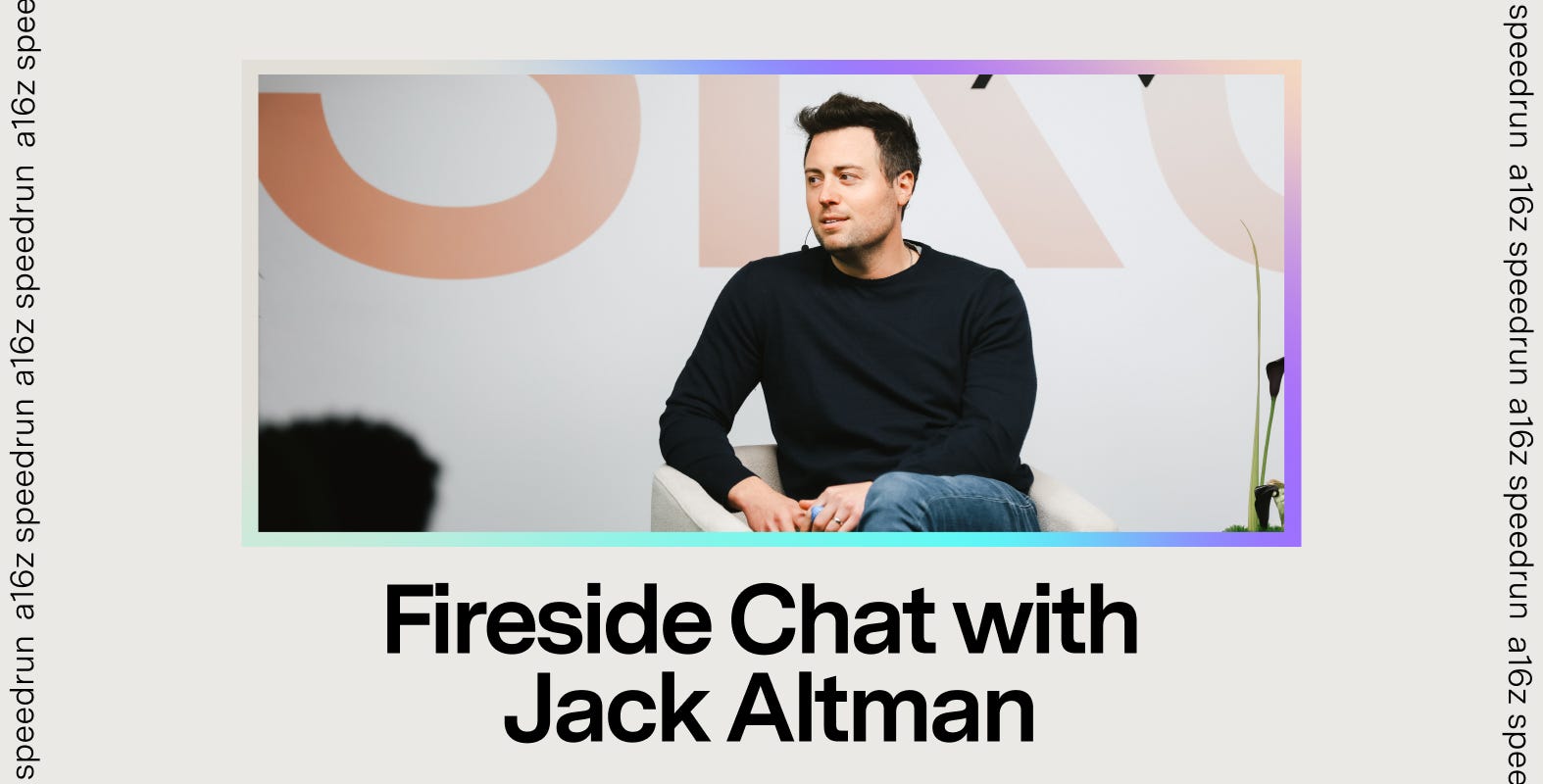
Jack Altman is the managing partner of Alt Capital, a $275 million early-stage fund, and the co-founder and chairman of Lattice, an HR platform used by more than 5,000 companies. He is also the host of the podcast Uncapped with Jack Altman.
In a recent fireside chat before an audience of a16z speedrun founders, Jack Altman sat down with a16z speedrun investor Marcus Segal to discuss what actually matters at the seed stage.
Watch the full talk:
Our top takeaways below 👇
1) Your first ten hires should be diamonds in the rough
When Segal asked about hiring a startup’s first employees, Altman was blunt about the math. A truly great early hire has to be someone the rest of the market hasn’t figured out yet.
“In order to be a great company, you need a high percentage of your first ten employees to be truly great. There are almost no examples of great companies where that didn’t happen. So that’s the task at hand.
“You also have to take the pragmatic view that for an obviously great employee, it doesn’t make that much sense for them to be the sixth employee of a startup. If they are that obviously great, they’re going to get ten gazillion dollars from a frontier lab or SpaceX or whatever, or they’re going to get an exec job at some super hot series D company, or they’re going to be a founder. So what you’re really looking for is diamonds in the rough. People who are in fact great, but are not legibly great to the entire world. It’s the only way.”
Altman saw the same pattern when hiring Lattice’s early sales team. The reps they pulled from large orgs wanted a playbook and a process that didn’t exist yet. The ones who worked were creative and entrepreneurial, willing to figure it out as they went.
2) When stuff works, it works fast
Lattice’s performance review product, the one that made the company, was actually its third pivot. Altman said the first two attempts had the right problem but the wrong solution.
“Most of the time when stuff works, it works fast. And I still believe that. That’s not a hard and fast rule. There are things that take time. There are situations where you don’t quite have product market fit, and it is actually right on the other side of a few more features or a little bit more sanding of the edges. But directionally speaking, when people want what you’re selling, you know quickly.
“We just weren’t getting the pull. It always seemed like one more feature, one more feature. And it was just never there. And then on a third attempt, everything was broken and we sold it anyway.”
Altman shared a vivid example of how scrappy that early traction looked in practice. When Lattice launched its first paying performance review customers, the product didn’t yet have a way to close a review cycle. His co-founder Eric Koslow was programming the ending while the first customers were already running their reviews. “They were on the beginning of the roller coaster that didn’t yet have the end,” Altman says.
3) Have a North Star for your product, and protect it
The tension between listening to customers and protecting your roadmap came up repeatedly. Altman acknowledged there’s no clean rule for it. Both extremes fail.
“It’s obviously wrong to scramble to [respond to] every single customer request. It’s also wrong to ignore it all… like, ‘No, I know best.’ You’ve got to have some North Star vision of your product. But customers are good at helping fill in the gaps within that outline.
Where it gets really hard is when a single deal threatens to pull you off course.
“One of the trickiest things is when some big enterprise comes along like, ‘Hey, we’ll give you $400,000 a year if you do this thing that zero other customers have asked you for,’ and right now you’re at $220,000 of ARR and you’re like, ‘Oh, I could triple if I just derail myself for like a month.’ It’s kind of tempting. And usually that’s a hard call.”
Segal added: “But it’s never a month, and it’s never their last ask.” Altman agreed, but pushed back against a blanket rule. He pointed to Stripe, whose early roadmap was shaped by large customers like Shopify and Lyft, and those features ended up helping everyone else. The judgment call is whether the request opens up a broader market or just serves one account.
4) Do your work proactively, not reactively
When Segal asked for one habit that compounds over time, Altman’s answer was about protecting your attention.
“You want to do as much of your work proactively versus reactively as possible. As time goes on, it is really easy to just work out of your inbox rather than off your to-do list, or take meetings that somebody else asked for rather than ones that you asked for. A lot of people end up doing reactive work ninety percent of the time, and it should be like nine percent of the time.”
Altman connected this to a broader point about staying close to the product. Once a company gets past about twenty people, the CEO’s job shifts from building the product to building the machine that builds the product. That transition makes it easy to lose touch with what customers actually experience. Someone described this to him as “taking ice cores all over the company all the time,” constantly sampling to make sure the micro still works.
5) No advice is right for 100% of companies
Altman offered this useful meta-observation about startup advice in general:
“Any advice that you get that’s given to a group of companies is doing its best to fit to the highest number possible. But there’s no advice that’s right for one hundred percent of companies. If you listen to it all as dogma, something’s going to be wrong for sure.”
He applied this principle to his own answers throughout the talk. On hiring: “This is eighty percent confidence advice. There are tons of other examples.” On building scrappy early product: “Standards from customers are a little bit higher now. So I’m less confident on this.”
On fundraising, he was more direct: follow the template your accelerator gives you, run a compressed timeline, and don’t let investors drag you into a premature process: “If you don’t have a term sheet, you’re not being preempted.”
That’s it for this week. Thanks to Jack for sharing his insights with our founders.
Like this post? Forward it to your team! And for more weekly dives into the world of early stage startups, subscribe below.
The 'gravity' framing is the cleanest test we've seen — when users come back without being pushed, you're done arguing about whether you have PMF. The trap is treating execution speed as the proxy for momentum. Speed without pull is just an expensive hamster wheel. Which of the 5 lessons do you think most founders ignore until it's too late?