

Case Study: The Evolution of a Pitch Deck
How one speedrun company honed their pitch between application and Demo Day


Calling all operators, executives, and the AI-curious! Join us at New York Tech Week for our first ever east coast AI Faire. Meet 20+ speedrun founders and explore live demos of the AI tools they’re building.

One joy of working with founders through speedrun is seeing how quickly teams evolve. Some teams get accepted into the program and end up pivoting completely. They go down a rabbit hole and end up chasing an adjacent idea.
Others stick to their guns and iterate, becoming ever more refined in the process. Concorda (SR006) is one of those. Today, they’re kindly allowing us to show their transformation in public.
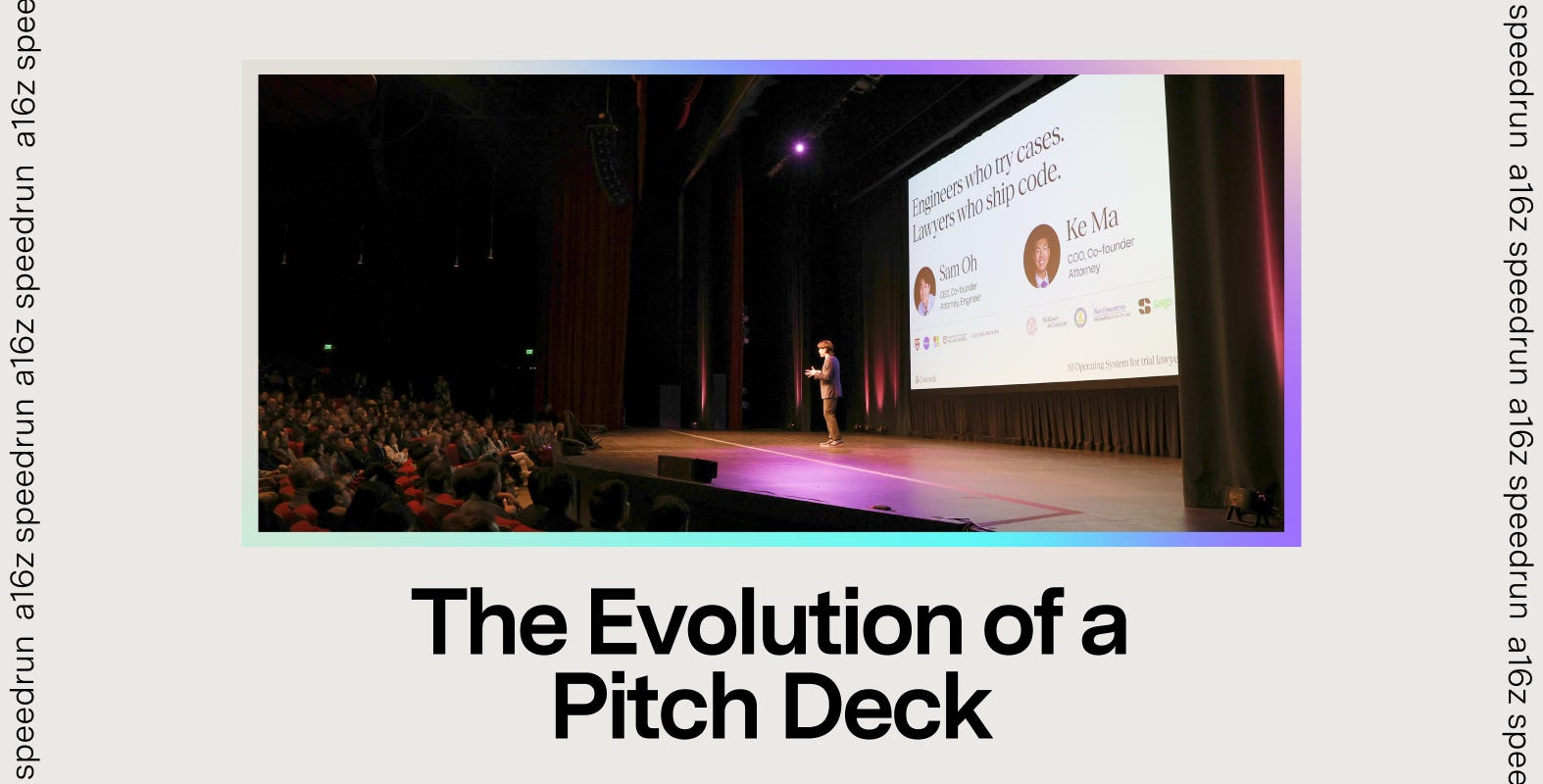
Sam Oh and Ke Ma first met in 2021, in an elevator in Chicago in a building where they both lived. Sam was a software engineer at a startup and Ke was attending law school at Northwestern. The two immediately hit it off, and since it was Ke’s birthday, he invited Sam to his party that same day. “We’ve been best friends ever since,” says Ke, now the COO and cofounder of Concorda.
Before founding a startup together, the two did a whirlwind tour of the legal world. Ke worked at McKinsey & Company and as an Assistant State’s Attorney at the Cook County State’s Attorney Office, before leading operations at Sage, a YC-backed startup in the healthcare sector. Sam did tours of duty at Fish & Richardson, Latham & Watkins, and Avantech Law.
The Founder Journey Begins
Sometime in 2025, Sam and Ke got together and began to develop an idea for a startup that would apply agentic AI tech for trial lawyers. The duo found their way to speedrun through a referral to a speedrun investor, Emily Bennett, late in the application cycle for SR006. “We prepared thoroughly for our interviews, pitched our backgrounds, and showed that we had a deep understanding of the market,” Ke says. Emily loved the pitch and extended the team an offer.
From the jump, Concorda had a fairly clear vision and story to tell about what they wanted to build. But that story evolved as they went through speedrun and ultimately pitched at SR006 Demo Day.
To show that evolution, below we’re sharing both the decks Concorda submitted when originally applying to speedrun and when presenting at Demo Day at the conclusion of the 12-week program. (Some numbers redacted for confidentiality.)

Slide 1: Positioning for Ambition
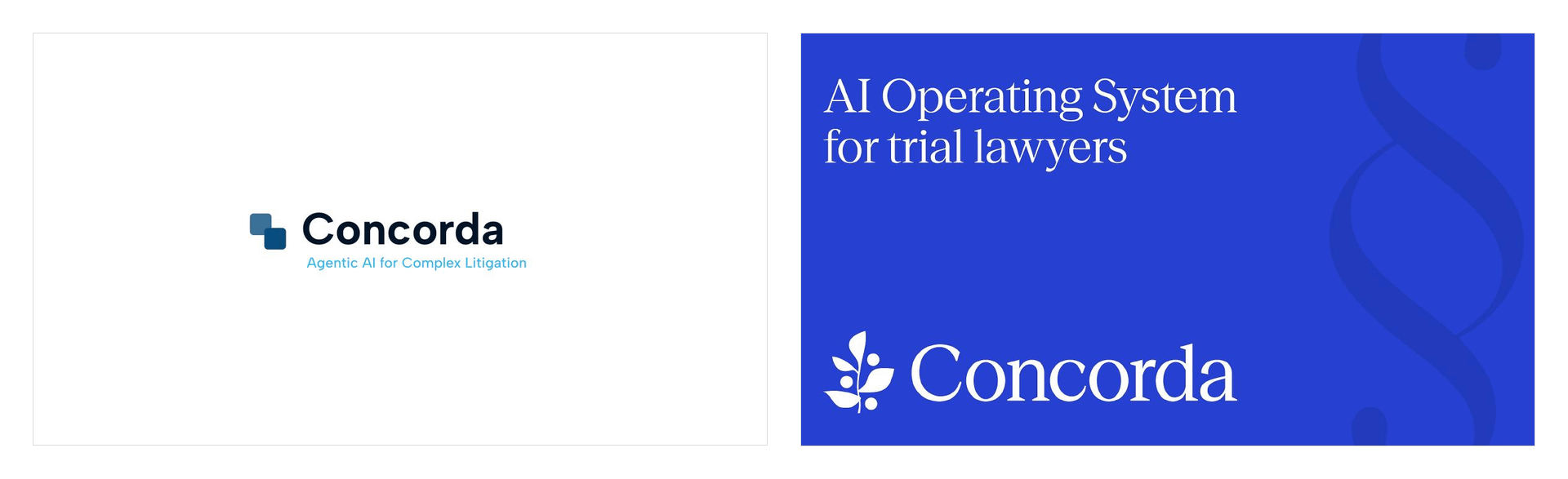
The level-up in the branding is obvious, thanks to the Concorda team leveraging speedrun’s “Brand Lab” program to develop a new logo, color and font system, and style guide. Our own Lester Chen can tell you more about Brand Lab. Onto the content:
The initial pitch of “Agentic AI for Complex Litigation” is defensible and reasonable: exactly what you would expect from former lawyers. But the new version, “AI Operating System for trial lawyers” is more clear about who the end-user is, and the vision is simply bigger. The implication is that ultimately Concorda aims to build everything a trial lawyer needs.
“We learned to be both more precise with our internal plans, and more ambitious in our overall vision for the company,” says Ke.
Slide 2: Dress for Success
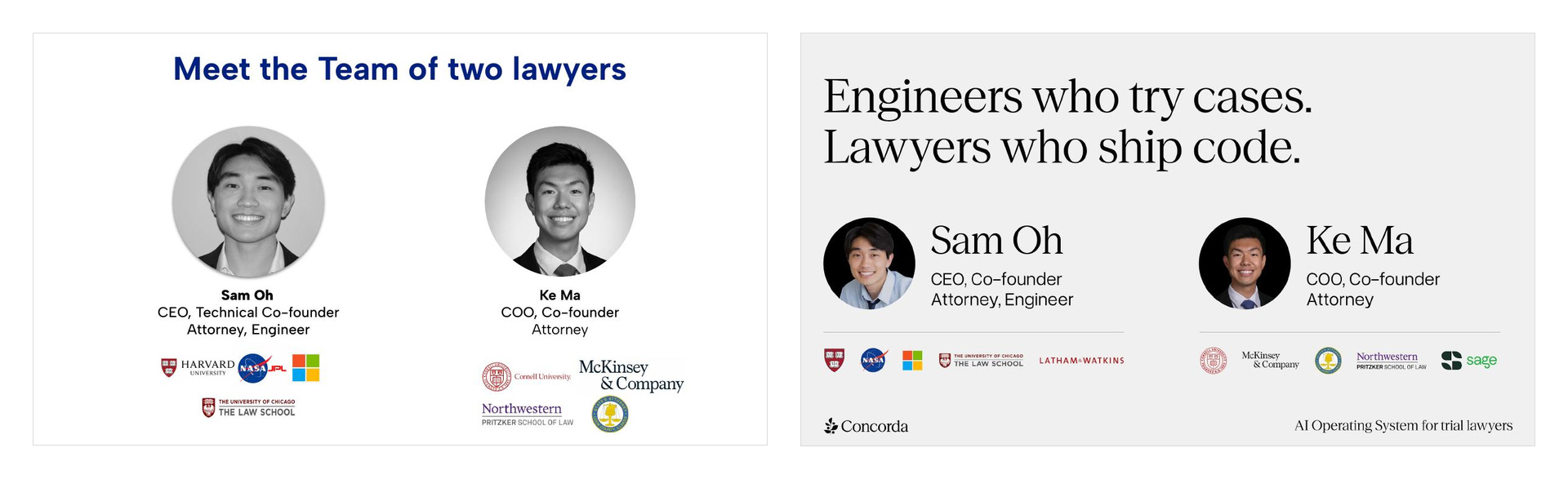
One thing that speedrun GP Andrew Chen likes to tell founders is “brag about yourself more.”
If the title slide introduces the vision, the team slide shows why the founders are the best people on the planet to pull this off. Ideally, you establish why you have unfair insights about your target market and why you have the technical chops to build a product that takes advantage of those secrets. “Engineers who try cases. Lawyers who ship code.” is a pithy way to accomplish exactly that.
Slide 3: Show ‘em the Money
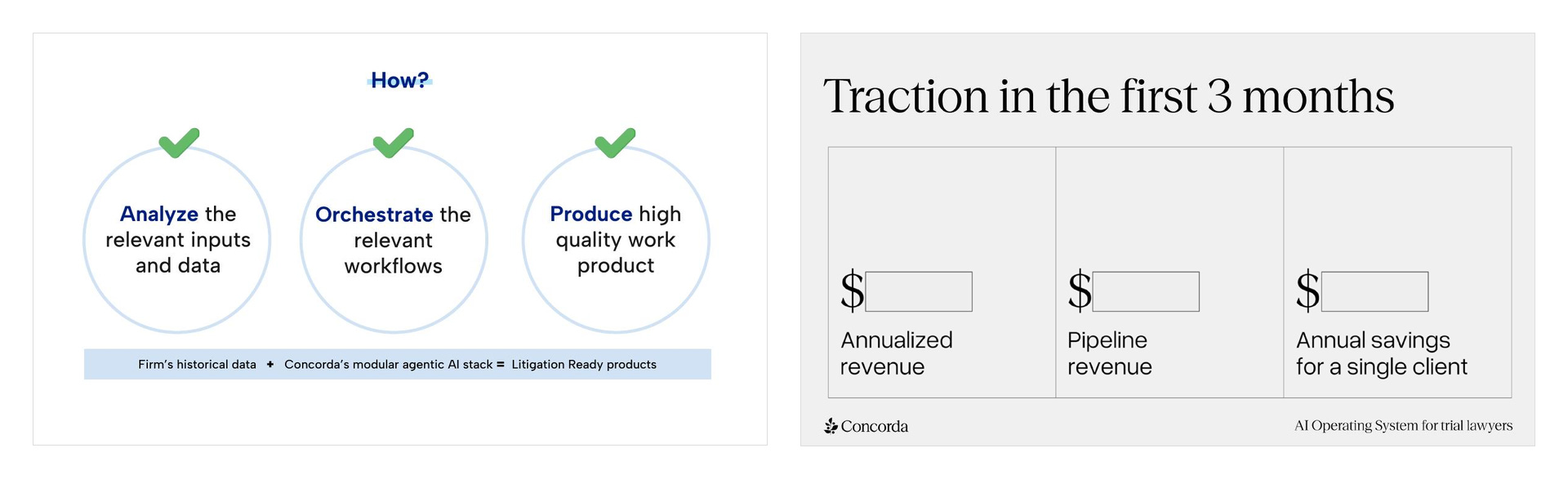
Ideas are great, but money talks. When teams apply to speedrun, many don’t have revenue. But by the time you get to Demo Day, it helps to show some progress. Concorda’s real deck had unredacted numbers in straightforward, plain language.
Slide 4: From Mission Statement to Problem Statement
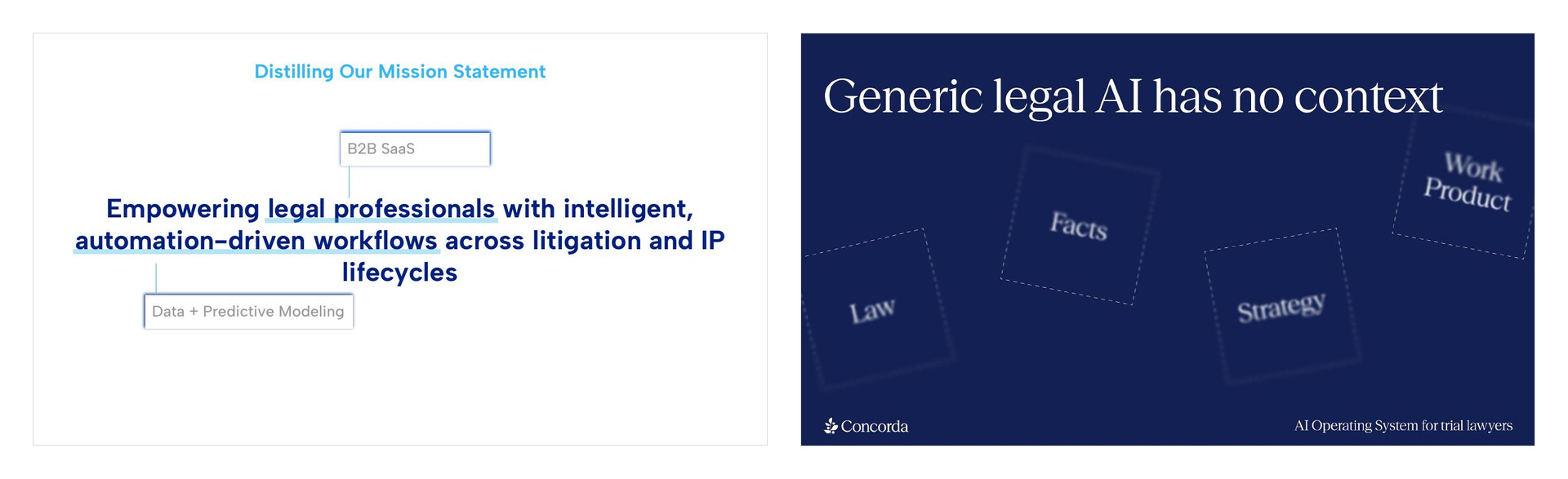
Originally, Concorda’s deck had a slide with a mission statement with callouts annotating which words mean what. But this was a little redundant with the title slide, so Concorda swapped it out for a more compelling problem statement. When presented on stage or on a call with investors, you can extrapolate on a slide like this with anecdotes and specific examples about why it’s a problem that, for example, “generic legal AI has no context.”
In Concorda’s case, they could defend this conclusion by pulling from Sam’s story of being the AI specialist at a litigation boutique and Ke’s background at Cook County State’s Attorney Office. The goal is to show the market the gap you understand better/different than everyone else. Problem statements describe a world the investor already knows is broken. And in this case, it’s a world the founder has already audited firsthand.
Slide 5: TAM and the Limits of the Possible
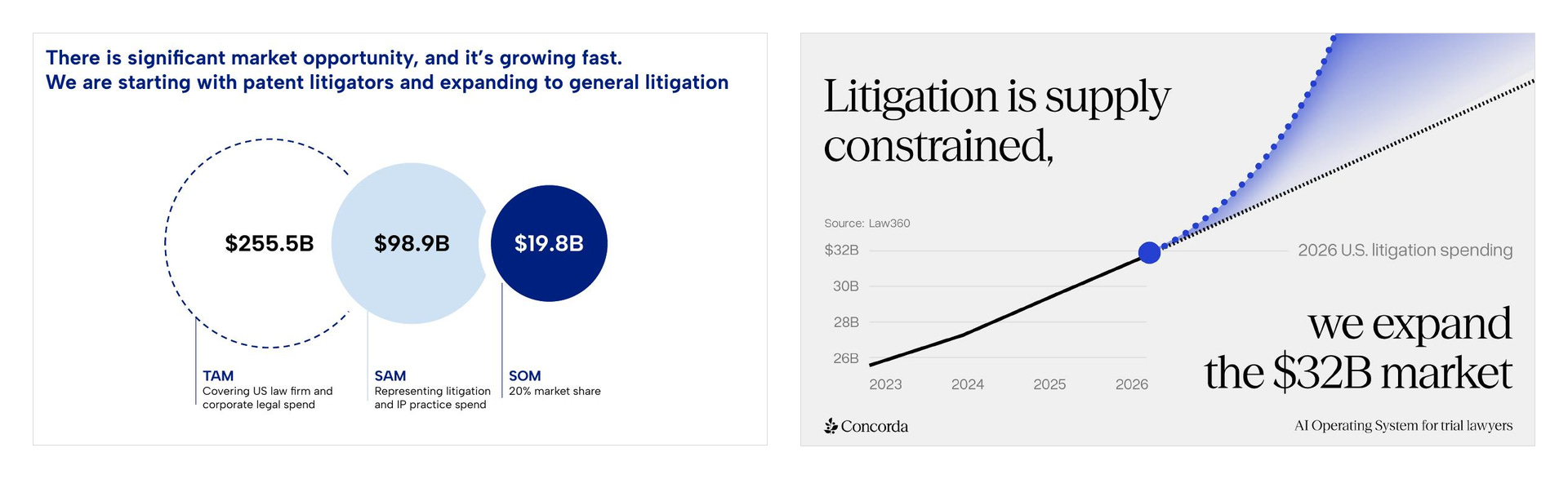
Let’s be honest: TAM is mostly just a vibe. Nobody actually knows what the TAM for your market is. And besides, generational startups invent markets. They change how work is done.
When making your TAM slide show the key constraints restricting market size, and then show how your product unlocks those constraints. You can be more realistic about it, it makes you more believable.
Slide 6: Send it Home
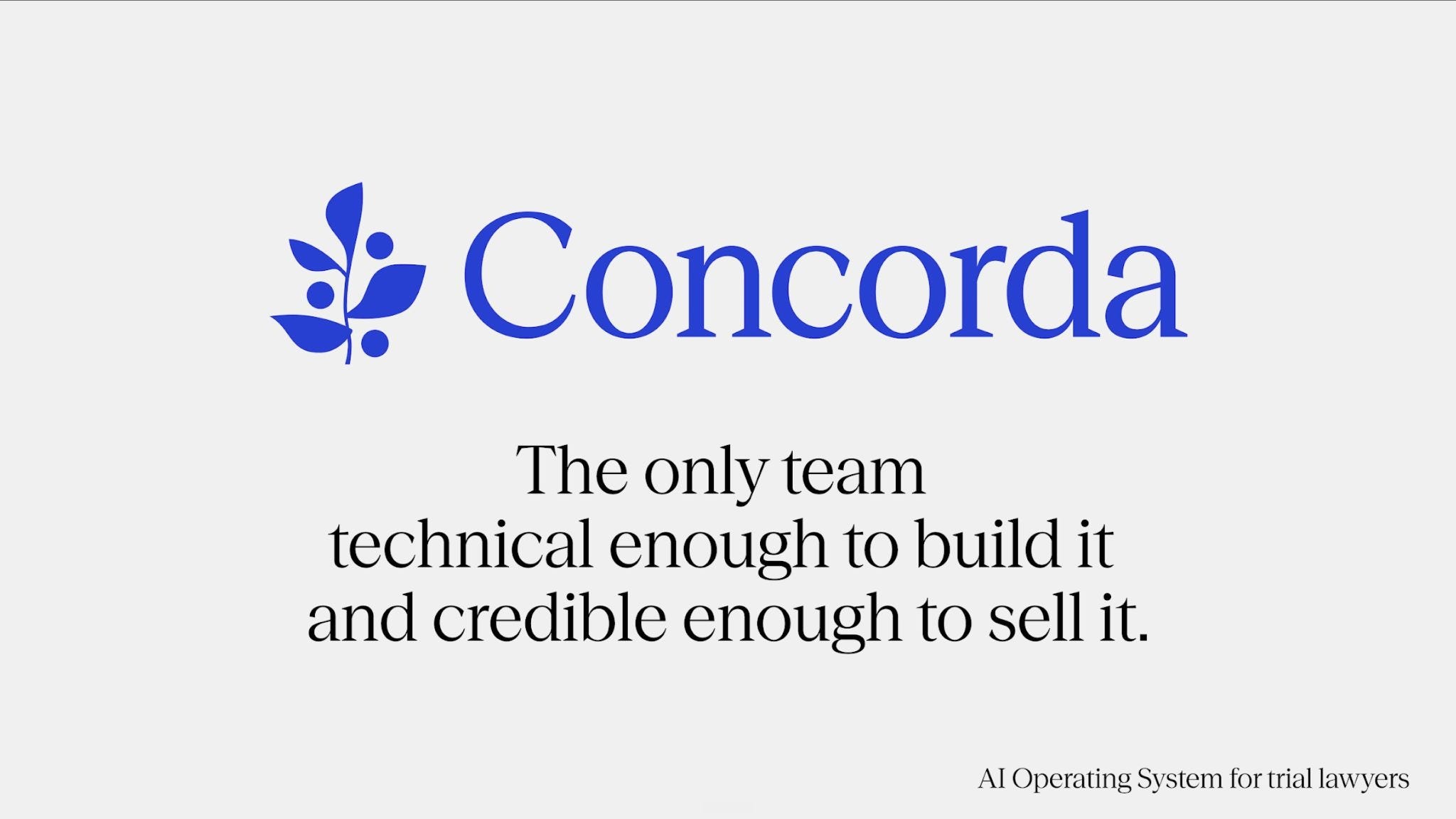
Concorda took Andrew Chen’s advice to brag more to heart, and ended their Demo Day deck with a humdinger of a brag. Great walk-off line.
That’s it for this week! For more weekly dives into the world of early stage startups, subscribe below.
But if I submit this type of pitch deck to the a16z speedrun application where I won't be presenting my pitch deck would it still work because there are alot of chances of getting misconception
I mean, if you only see the final pitch deck, you think the secret is the slide order. the actual secret is pivoting twice before landing on the right problem